SIM Cards, eSIMs, and Data Plans for Month-Long Stays Abroad
Compare roaming, local SIMs, and eSIMs for month-long European stays. Real costs, coverage trade-offs, and setup advice for remote workers.
Your first Zoom call from Lisbon should not be the moment you discover your carrier is billing you fifteen dollars a day for roaming. For a thirty-day stay, that works out to four hundred fifty dollars before you have used a single gigabyte for an actual video call. Mobile data is a professional expense when you are working remotely, and picking the wrong option can cost you real money and real headaches. The good news is that the landscape has improved considerably. The bad news is that no single option works for every situation, every destination, or every traveler.
The 30-Day Data Picture
- International roaming from US carriers typically costs $10 to $15 per day, making it impractical for any stay longer than about one week.
- A local SIM bought after landing gives you the best data value for the money, but it requires a carrier store visit and sometimes passport documentation.
- An eSIM loaded before departure lets you skip the store entirely and keep your home number active on the same device using dual-SIM.
Three Options, Very Different Trade-Offs
Remote workers doing extended stays in Europe have three realistic paths for mobile data. The first is sticking with international roaming from their home carrier. The second is buying a physical SIM card from a local carrier after landing. The third is loading an eSIM onto their phone before they leave. Each one carries real costs, real friction, and real compromises. None of them is objectively better than the others in every situation. The right call depends on where you are going, how long you are staying, and whether your team needs to reach you on a consistent number.
If you are spending a full month in one city, the calculation looks different than if you are splitting time between Berlin, Amsterdam, and Madrid. The same goes for your phone setup. A dual-SIM device changes your options significantly compared to a single-SIM model.
International Roaming Costs More Than You Expect
Most major US carriers offer daily international passes that activate your domestic plan abroad. AT&T's International Day Pass runs around $12 per day. Verizon's TravelPass sits at the same price. T-Mobile includes international data in many of its higher-tier plans, but at severely throttled speeds, typically 128 kbps. That is insufficient for a video call.
Run that math for a full month. At $12 per day, you are looking at $360 before any taxes or fees. You still have the same speed limitations baked into most carrier pass plans, which cap data at high speed before throttling kicks in. That throttle makes roaming plans essentially useless for anything beyond messaging and basic browsing. A 1080p Zoom call needs roughly 1.5 to 3.8 Mbps of upload. At 128 kbps, you will not get anywhere near that.
UK travelers face a similar picture. Since 2022, most UK carriers reinstated roaming fees in Europe following changes to UK regulations. Operators like EE and Vodafone UK charge between £2 and £5 per day for European data passes. For a thirty-day stay, that is £60 to £150, with the same speed constraints as their US counterparts.
Roaming plans make sense for short trips of four to seven days, or for travelers who need absolute simplicity and do not mind paying a premium. For anyone doing a real working month abroad, they are generally the wrong tool for the job.
Buying a Local SIM After Landing
A physical SIM purchased from a local carrier is almost always the cheapest option for data, with the most reliable coverage in your destination country. Italy's Iliad offers unlimited data plans starting at around €9.99 per month. Portugal's NOS and MEO both run prepaid plans in the €10 to €15 range. French carriers like Bouygues and Free Mobile start around €15 to €20 for generous data allowances. Germany sits slightly higher, with Congstar and aldi talk offering solid 30-day plans for €20 to €25.
There is also a meaningful cross-border benefit if your itinerary includes multiple EU countries. A card purchased from a major German carrier crosses into Austria, Poland, or Spain at the same domestic rate, covered by EU roaming protections that have been in force since 2017. That matters if you are planning more than one stop during your stay.
Before you head to a carrier store, there are a few things worth knowing ahead of time:
- Your phone must be unlocked. Carrier-locked phones will not accept a foreign SIM. Check this before you leave home, not at the store counter.
- Bring your passport. Most EU carriers require government-issued ID to register a prepaid SIM, and some will not process without it.
- Expect some language friction at smaller shops. A translation app or a pre-written request in the local language helps significantly in France, Italy, and rural Spain.
- Your existing home number goes dark while the new SIM is active, unless your device supports dual-SIM.
- Topping up mid-month is usually straightforward through a carrier app, but some prepaid plans expire after thirty days regardless of remaining data.
Workers who arrive knowing exactly which carrier they want, what plan to ask for, and which store to visit on day one will have a smooth experience. Workers who land jet-lagged and try to sort it out at an airport kiosk often end up paying twice as much for a tourist-targeted plan that makes roaming look reasonable by comparison.
eSIMs and the Case for Pre-Trip Setup
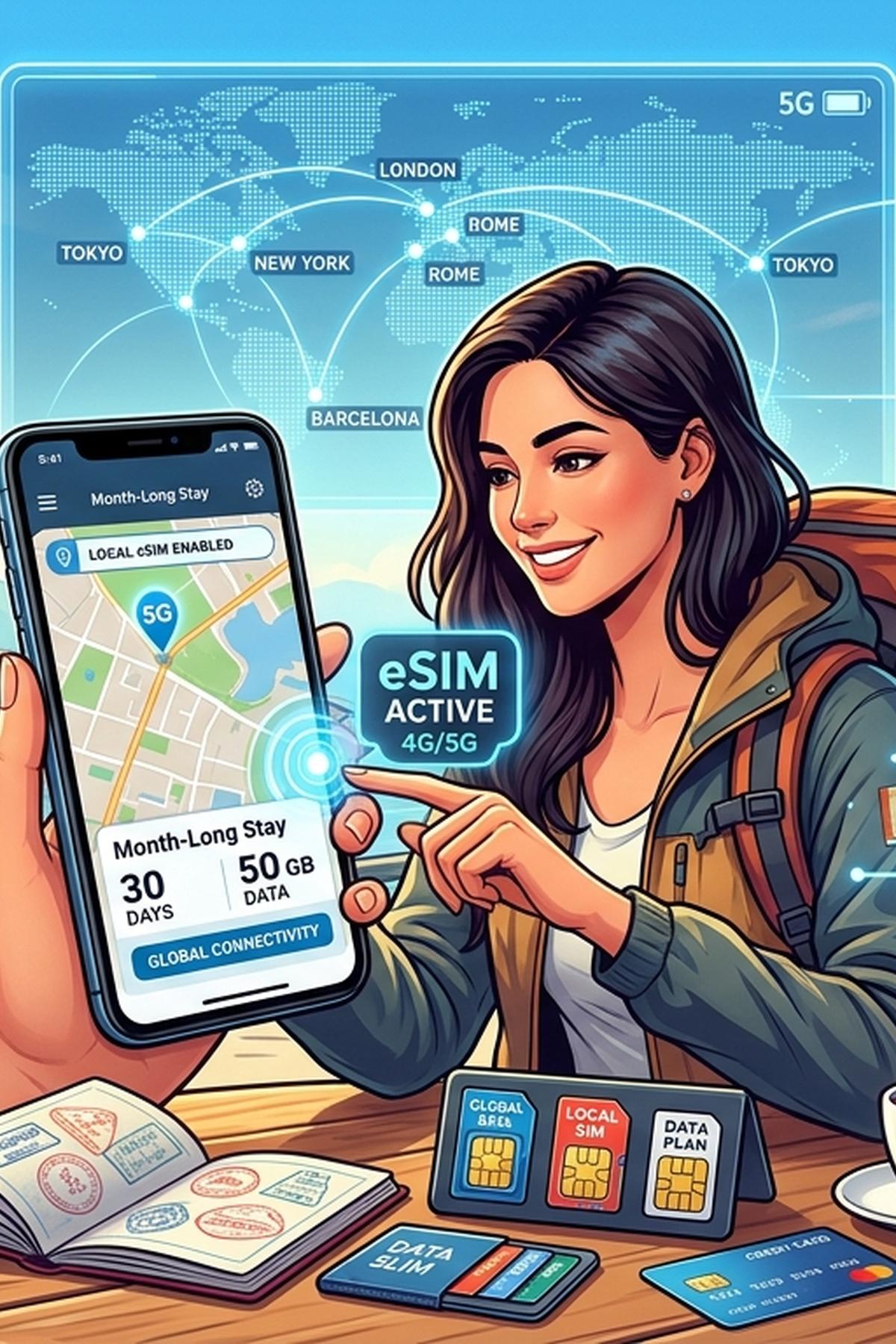
An eSIM is a digital SIM card embedded directly into your phone. Instead of swapping a physical card, you scan a QR code or download a carrier profile, and your phone connects to that network. The practical upside for remote workers is that you can set everything up from home before you board the plane.
eSIM coverage in Europe has expanded rapidly over the last few years. Germany, France, Spain, Portugal, Italy, and the Netherlands all have strong eSIM infrastructure through local carrier partnerships. Compatibility with iPhones from the 12 series onward and most flagship Android models is solid. The primary caveat is that older devices, or budget Android handsets, may not support eSIM at all. Check your phone's specifications before counting on this option.
Monthly data costs through eSIM providers vary depending on the region covered and the data cap. Providers that offer a monthly eSIM plan give you a rolling subscription structure that avoids the need to hunt down a carrier store every time you move to a new country. For workers who are either moving between EU countries during a stay or who simply want everything resolved before their flight lands, this structure is considerably easier to manage.
One underrated advantage of the eSIM path is dual connectivity. Most modern phones can run a physical SIM alongside an eSIM simultaneously. That means your US or UK number stays active for incoming calls from your team while the eSIM handles all your data. You do not have to choose between your work number and affordable local data. You can have both running at the same time.
The trade-off is that eSIM providers typically cost more per gigabyte than a local prepaid SIM, and coverage quality depends entirely on which network they have partnered with in each country. A good eSIM provider will clearly document which local carrier their data routes through. If they are running through a strong network like Deutsche Telekom in Germany or Orange in France, speeds will be solid. If the partner network is unclear, that is a reason to pause before committing.
What Coverage Actually Means for Video Calls
Coverage maps published by carriers are generous with the truth. A map might show 5G blanketing an entire metropolitan area when the actual 5G signal is concentrated in the city center and a handful of transit corridors. For most of your working hours, spent indoors in an apartment or a coworking space, the question is not whether you have any signal. The real question is whether you have enough upload bandwidth for a consistent video call.
A standard Zoom or Google Meet call requires roughly 1.5 to 3.8 Mbps of upload at 1080p. Microsoft Teams calls have similar requirements. That is achievable on 4G LTE in almost any major European city. Paris, Berlin, Amsterdam, Lisbon, Barcelona, and Tallinn all have strong 4G infrastructure that reliably supports remote work video. Rural areas are a different story. If your month includes time in the French countryside, the Italian coast outside of major cities, or the interior of Portugal, expect more variability.
The practical move is to run a speed test on your local or eSIM connection from the actual apartment you are renting, before your first scheduled call. Do not trust the signal bar. Run the test during your working hours, not at midnight when the network is quiet, and test both download and upload separately. Upload is the number that matters most for video.
Which Plan Fits the Trip You're Actually Taking
There is no universal answer. The right data setup depends on the specific shape of your trip and your work situation. Think of this as a matching exercise rather than a ranking.
If your team calls you by phone rather than through a messaging app, you need a stable number. That typically means keeping your physical SIM active for voice calls and using an eSIM for data, or accepting that your home number will be unreachable for the month while a local SIM is inserted. Make sure your team knows which channel to use before you leave, not after a missed call on day two.
If you are visiting only one country for the full thirty days, a local SIM almost always gives you the best price-to-performance ratio. The setup cost is one trip to a carrier store. After that, you have reliable data for the rest of the month at a fraction of what roaming would have cost.
If you are splitting time between multiple EU countries, or if you want everything configured before your flight departs, an eSIM with a rolling monthly structure is the lower-friction option. You will pay a slight premium compared to a local SIM, but you gain flexibility and skip the in-person store experience entirely.
Here is how the options break down by situation:
- Trip of seven days or fewer, simplicity is the priority: roaming from your home carrier is probably fine.
- Single-country stay of thirty or more days, comfortable with one store visit on arrival: local SIM from a major carrier.
- Multi-country itinerary or no interest in carrier stores: eSIM with a monthly rolling plan.
- Need to stay reachable on your home number for team calls: dual-SIM setup with your home physical SIM for voice plus an eSIM for data.
- Older or budget device without eSIM support: local SIM is your only real alternative to roaming.
Workers who sort this out two weeks before departure almost always have a smoother month than those who land with no plan. Mobile connectivity for a working month abroad is not complicated. It just requires making one deliberate decision ahead of time, and not leaving it to chance at the airport kiosk.